Spanish Village Balboa Park: Art Studios, Hours & Tiles
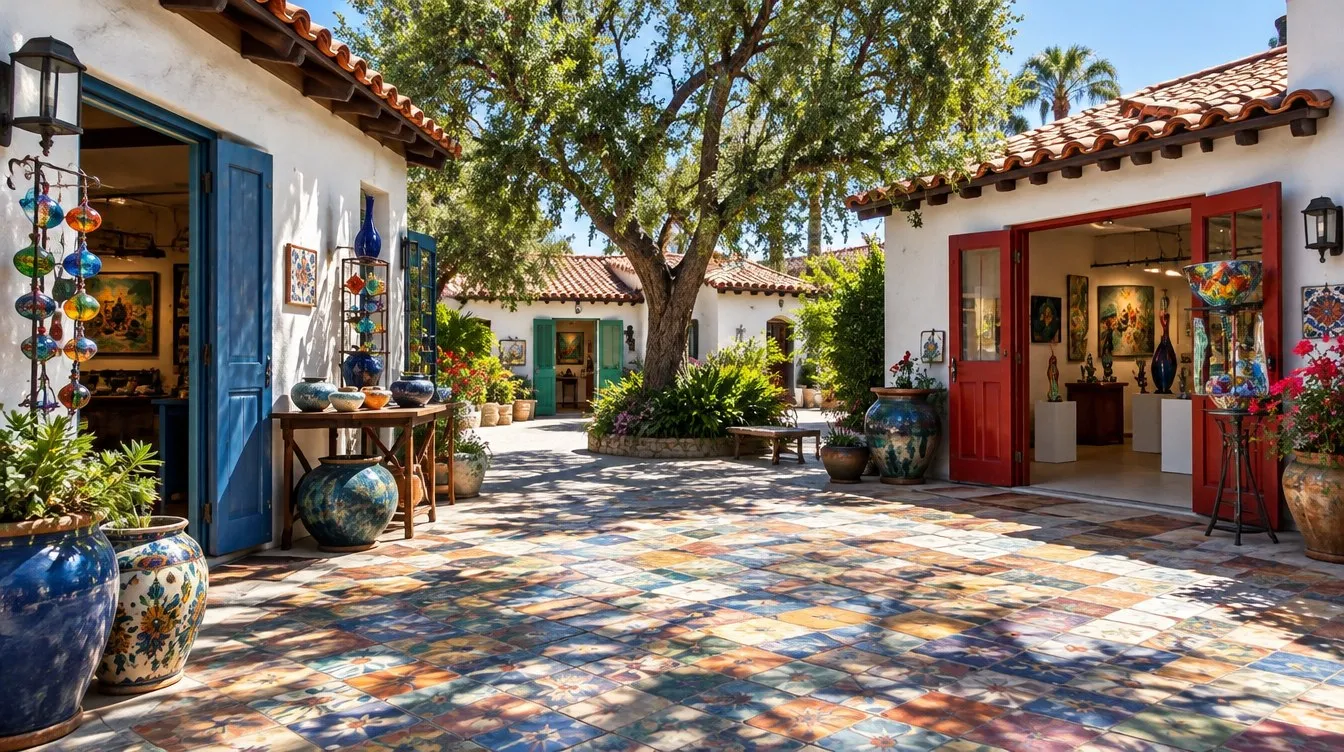
Spanish Village is a cluster of small, brightly painted studios in Balboa Park where you can watch local artists work and buy directly from them. It’s open daily from 11 a.m. to 4 p.m., and admission is free. Plan on 45 minutes to an hour, longer if you get talking with a glassblower or potter.
What Spanish Village is
The complex was built for the 1935 California Pacific International Exposition and designed to look like a village in the Spanish countryside. Architect Richard Requa planned it as a temporary exhibit, and it was expected to come down when the fair closed. Local artists asked to turn the empty buildings into workspaces instead, and the art colony grew from there. During World War II the US Army used the buildings and the artists had to leave. They came back in 1947 and repaired the structures themselves in exchange for rent-free use.
Today the Village Arts Center, the name the artists’ organization now uses, has roughly three dozen studios and galleries. More than 200 independently juried local artists show work there: painters, sculptors, potters, jewelers, metalsmiths, photographers, printmakers and glass artists. There’s an onsite glassblowing facility, and demonstrations happen in the studios and out on the courtyard.
You’ll see both names. The artists’ own site and some event listings say “Village Arts Center,” while Balboa Park’s official guide, park maps and almost everyone else still say Spanish Village or the Spanish Village Art Center. The address for all of them is 1770 Village Place, San Diego, CA 92101.
The colored tiles
The feature most people photograph is the ground itself. In the 1980s the artists painted the courtyard’s paving tiles in bright colors and patterns to make the plaza more inviting. The tiles are believed to be made from rubble of buildings demolished in the 1930s. Doors, window frames and facades got the same treatment, so the whole courtyard reads as one big piece of folk art.
The tiles look best in soft morning or late-afternoon light, and when the courtyard is quiet. Weekday mornings right at opening are the calmest time to shoot them.
Inside the studios
Each studio is run by an individual artist, a small group, or a guild. You can walk into any open door, look around, and ask questions. Many artists work while the studio is open, so you might catch someone throwing a pot, carving wood or shaping hot glass.
Painting studios
Searches for “Spanish Village paintings” usually come from people hoping to buy an original local piece. Several studios show oils, watercolors and mixed media, much of it of San Diego subjects: the coast, Balboa Park’s towers, desert scenes. Prices vary a lot from artist to artist. Buying here means the money goes straight to the person who painted it, and many artists will tell you about the piece or take a commission.
The guilds
Several juried guilds keep permanent studios in the village. Current listings name the San Diego Potters’ Guild, the Art Glass Guild of San Diego, the Sculptors Guild, the Enamel Guild, the Southwestern Artist Association and the San Diego Woodcarvers Guild.
The San Diego Enamel Guild has worked out of Studio 5 since 1982, according to its listing. Members fuse powdered glass onto metal at high heat to make jewelry, bowls, vessels, wall panels and small sculpture. It’s a technique most people have never seen up close, and it’s one of the more unusual stops in the village.
The old version of this page also mentioned the San Diego Polymer Clay Guild. It doesn’t appear in any current list of Spanish Village guilds we could find for 2026. If polymer clay is what you came for, ask at the studios or check the artists directory before you make the trip.
Guilds hold seasonal shows and sales, often out on the patio. The potters and the glass guild both put on fall and holiday sales, and these are the best times to see a wide range of work in one visit.
Hours, cost and when to go
| Detail | What to know |
|---|---|
| Hours | Daily, 11 a.m. to 4 p.m. |
| Closed | Thanksgiving, Christmas, New Year’s Day |
| Admission | Free |
| Address | 1770 Village Place, San Diego, CA 92101 |
| Time needed | 45 to 90 minutes |
Individual studios open at their artists’ discretion, so a door or two may be closed on any given day. Weekends draw the biggest crowds. Weekdays are usually quieter, which makes it easier to talk with the artists.
December Nights is the big exception to the 4 p.m. close. During Balboa Park’s holiday festival the studios stay open late, until 10 p.m., with an art festival, holiday performances on the village stage and photos with Santa. In 2026, December Nights runs Friday, December 4 (4 to 10 p.m.) and Saturday, December 5 (noon to 10 p.m.). Expect big crowds. Our December Nights guide covers transit and parking for that weekend.
Classes and workshops
The Village Arts and Education Foundation runs classes, workshops and art camps through the year, including kids’ camps in school breaks. Topics change by season. Check the Village Arts Center site for the current schedule and fees.
Getting there and parking
Spanish Village sits near the San Diego Zoo entrance, at the north end of Balboa Park’s central area, and the park’s 1910 carousel is just behind it. If you’re on foot from El Prado, head toward the zoo entrance and follow the park’s wayfinding signs. If you want a map, put “1770 Village Place” into your phone’s map app, or use the interactive map on balboapark.org.
Parking in Balboa Park changed in January 2026, and it is now paid in most places:
- San Diego Zoo lot. Closest to the village. The zoo’s parking page lists a flat $16 per car per day, or $8 for registered City of San Diego residents. Zoo members park free.
- City lots in Balboa Park. According to the city’s Balboa Park parking page, nonresidents pay $10 to $16 a day depending on the lot, and registered city residents park free in the general lots. Paid parking runs through the end of 2026 and is scheduled to end January 1, 2027.
- Lower Inspiration Point. The first three hours are free for everyone. It’s the cheapest option for a short visit, then walk or take the park tram to the village.
- ADA placard or plate. Free in any city lot or at meters.
Enforcement runs 8 a.m. to 6 p.m. daily, except on major holidays. Rates and rules may change again in 2027, so check the city page before you go.
Who it suits
Spanish Village is a good fit for:
- Families who need a break between the zoo and the museums. Kids like watching glassblowing and pottery, and nobody hurries you.
- Anyone shopping for a gift that wasn’t made in a factory. Jewelry, small ceramics and enamel pieces travel well.
- Photographers. The tiles, doors and whitewashed walls give you lots of color in a small space.
- Budget travelers. It’s one of the best free things to do in San Diego.
It’s less of a draw if you only want large-scale fine art. For that, head to the museums along El Prado.
Nearby pairings
- San Diego Zoo. Right next door. A morning at the zoo followed by an hour in the village is an easy combination, and you won’t have to move the car.
- Balboa Park museums. The Natural History Museum and the museums along El Prado are a short walk south. See our Balboa Park museums guide.
- The carousel. The park’s 1910 carousel, with most of its original hand-painted animals, is right behind the village and an easy add-on with small kids.
Insider tips
- Arrive close to 11 a.m. if you want the courtyard and tiles without crowds.
- Ask before photographing an artist at work or their pieces. Most say yes.
- Payment methods vary by studio, so carry a card and a little cash.
- Buying something fragile? Ask the artist about wrapping it for travel or shipping it home.
- Hours can shift for events and holidays. The Village Arts Center site is the most current source.
Frequently asked questions
What are Spanish Village's hours in Balboa Park?
The studios are open every day from 11 a.m. to 4 p.m. and close on Thanksgiving, Christmas and New Year's Day. Individual studios are run by artists and guilds, so a few doors may be shut on any given day.
Is Spanish Village free to visit?
Yes. Walking the courtyard and browsing the studios and galleries costs nothing. You pay only if you buy art or sign up for a class or workshop.
Why are the courtyard tiles in Spanish Village so colorful?
Artists painted the paving tiles in the 1980s to brighten the plaza and draw visitors. The tiles are believed to come from rubble of buildings demolished in the 1930s, so the colorful ground is itself part of the village's history.
Is the San Diego Enamel Guild in Spanish Village?
Yes. The San Diego Enamel Guild works out of Studio 5 and has been there since 1982. Members fuse powdered glass to metal to make jewelry, bowls, wall panels and sculpture.
Where should I park for Spanish Village?
The San Diego Zoo lot is the closest, but it charges a flat daily fee in 2026. City lots elsewhere in Balboa Park are also paid for nonresidents through the end of 2026, and Lower Inspiration Point gives everyone the first three hours free. Check the city's Balboa Park parking page before you go.
Is Spanish Village now called the Village Arts Center?
The artist organization now brands itself as the Village Arts Center, and some listings use that name. Signs, maps and most visitors still call it Spanish Village or the Spanish Village Art Center. They are the same place at 1770 Village Place.
Hours, prices and event dates change. Confirm with the venue or organizer before you go.