San Diego Weather by Month: Sunny Days, Ocean Temps, June Gloom
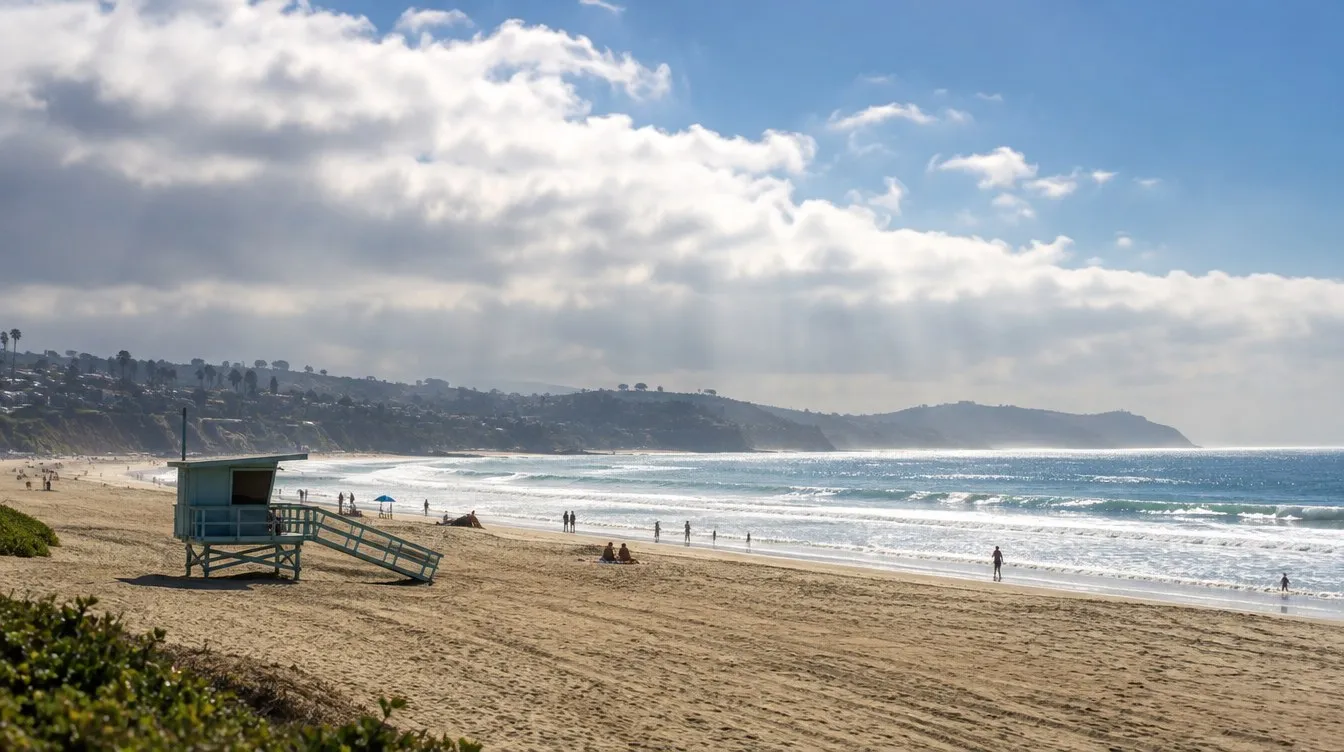
San Diego weather is mild all year. Average highs at the airport run from about 66°F in winter to 77°F in late summer, and the city gets under 10 inches of rain a year. The two things that surprise visitors are the cool ocean and the gray marine-layer mornings of May and June, so plan around those and most trips work out.
San Diego weather by month
Air temperatures and rainfall below are NOAA 1991–2020 normals for San Diego International Airport (Lindbergh Field), rounded to the nearest degree. Ocean temperatures are the long-term monthly averages (1916–2024) at Scripps Pier in La Jolla, from the Scripps Shore Stations Program, converted to Fahrenheit.
| Month | Avg high | Avg low | Rain (in) | Ocean (°F) |
|---|---|---|---|---|
| January | 66°F | 50°F | 1.98 | 58 |
| February | 66°F | 52°F | 2.20 | 58 |
| March | 67°F | 55°F | 1.46 | 59 |
| April | 69°F | 57°F | 0.65 | 60 |
| May | 70°F | 60°F | 0.28 | 63 |
| June | 72°F | 63°F | 0.05 | 66 |
| July | 75°F | 66°F | 0.08 | 69 |
| August | 77°F | 68°F | 0.01 | 70 |
| September | 77°F | 66°F | 0.12 | 68 |
| October | 75°F | 62°F | 0.50 | 65 |
| November | 71°F | 55°F | 0.79 | 62 |
| December | 66°F | 50°F | 1.67 | 59 |
| Year | 71°F | 59°F | 9.79 |
These are coastal numbers. Inland neighborhoods and valleys warm up faster on sunny days and cool off more at night, and the mountains and desert are a different climate altogether (more on that below).
How many sunny days does San Diego get?
It depends on how you count. Climate summaries built on NOAA data put San Diego at about 146 clear days a year (no more than 30 percent cloud cover) plus about 117 partly cloudy days, so roughly 263 days a year see at least some sun. Sunshine runs at about 68 to 69 percent of possible daylight hours, roughly 3,000 hours a year (Current Results, from NCEI normals).
The sunniest months by share of possible sunshine are winter (December through February, about 74 to 75 percent) and late summer. The least sunny are May and June, at under 60 percent. That’s the opposite of what most visitors expect, and it’s all down to the marine layer.
May Gray and June Gloom explained
From roughly May through early summer, many coastal mornings start under a flat, low gray cloud deck. Locals call it May Gray and June Gloom. It sometimes starts in April and can linger into July.
What causes June Gloom
In late spring the Pacific off San Diego is still close to its winter temperature, so the air sitting right on the water stays cool and damp. The air a few thousand feet up warms much faster. That warmer layer acts as a lid, a temperature inversion, that stops the cool surface air from mixing upward. Trapped moisture cools to its dew point and condenses into low stratus clouds: the marine layer (LAist explainer).
Heat building over the inland valleys and deserts pulls that ocean air onshore, which is why the clouds can push miles inland overnight. As the sun heats the top of the cloud deck through the day, it thins and burns off, usually earliest inland and last at the beaches. On some days it never fully clears at the coast. By August the ocean has warmed enough that the inversion weakens and gray mornings become less common.
What it means for your trip
- Plan beach time for the afternoon in May and June. Mornings are better for museums, the zoo or inland sightseeing.
- Drive inland for sun. The cloud deck usually clears first inland, so heading east is often the quickest way to find sunshine.
- Wear sunscreen anyway. UV still comes through thin cloud, and people burn on gray beach days.
- Gray-day backups: Balboa Park’s museums, such as the Fleet Science Center, are built for days like this.
National Weather Service data for San Diego also shows a quirk: fog at ground level is actually most common in fall and winter, while spring and summer bring the low overcast that usually lifts by afternoon (NWS San Diego climate summary).
Rainy season
San Diego’s rain comes mostly from December through March, when Pacific storms reach Southern California. February (2.20 inches) and January (1.98 inches) are the wettest months at the airport. The annual total of 9.79 inches falls on about 40 days a year, so even in winter most days are dry. Summer is close to rainless, though monsoon moisture from the east can occasionally bring humidity and a stray thunderstorm, mostly in the mountains and deserts.
Rain matters for the beaches. San Diego County advises avoiding swimming, surfing and diving for 72 hours after rain, because runoff carries bacteria to the coast, especially near storm drains, creeks and river mouths (Times of San Diego, Feb. 2026). Check current beach status at sdbeachinfo.com before you go in. That applies year-round in Imperial Beach, which is often closed because of Tijuana River sewage flows.
Season by season
Winter (December to February)
Highs in the mid-60s, lows around 50°F, and the year’s rain, usually in short storms with clear, crisp days between them. Ocean temperatures bottom out near 58°F, so surfers wear full wetsuits. It’s a good season for hiking and city sightseeing, and clear days after a storm are among the most beautiful of the year. Snow can fall in the county’s mountains (see our Mount Laguna guide), but the NWS says snow is practically unknown in the city itself.
Spring (March to May)
Temperatures climb slowly and rain tapers off after March. Spring is also when the inland deserts are most pleasant to visit. By late April and May the marine layer starts showing up more often at the coast.
Summer (June to August)
June is the gloomiest month at the coast, but by July the air is in the mid-70s and the ocean reaches about 69°F, rising to 70°F in August. Late August is typically the warmest stretch of the year at the coast. Book hotels early for summer, the peak visitor season.
Fall (September to November)
September and October are San Diego’s secret summer: highs in the mid-to-upper 70s, an ocean still near 68°F in September, very little rain and fewer gray mornings. NWS records for 1948–1990 also show that most of the city’s 90°F-plus days happened in September and October, typically during heat waves when hot, dry offshore winds (Santa Anas) push desert air to the coast. Those same winds raise wildfire risk inland. By November, nights cool down and the first winter storms can arrive.
Coast, inland, mountains and desert
San Diego County packs several climates into a short drive. The coast is the mildest. Inland valleys run hotter in summer and cooler on winter nights, and the marine layer often stops short of them. The mountains around Julian and Mount Laguna are much colder, with occasional winter snow. The Anza-Borrego Desert is very hot in summer and pleasant in winter. Check the forecast for where you’re actually going, not just “San Diego.” The NWS San Diego forecast office covers the whole county.
What to pack
- Layers, in any season. A light sweater or jacket for mornings and evenings, even in summer. Coastal temperatures drop quickly after sunset.
- A warmer jacket in winter, plus a compact umbrella or rain shell from December to March.
- Sun protection: sunscreen, sunglasses and a hat, including on gray days.
- Swimwear, and maybe a wetsuit. With the ocean in the high 50s to around 70°F, many swimmers rent a spring suit or full wetsuit, especially outside August and September.
- Closed shoes for hiking inland or in the mountains, and extra water for desert trips.
For where to spend those sunny afternoons, see our San Diego beach guide.
Frequently asked questions
How many sunny days a year does San Diego get?
Based on NOAA climate data, San Diego averages about 146 clear days a year (days with no more than 30 percent cloud cover), plus about 117 partly cloudy days. The sun shines for about 68 to 69 percent of possible daylight hours, roughly 3,000 hours a year.
What causes June Gloom in San Diego?
In late spring the ocean is still cool, but the air higher up warms quickly. That warm layer acts as a lid, an inversion, trapping cool, moist ocean air near the surface, where it condenses into a low stratus cloud deck called the marine layer. Heat inland pulls it onshore, and it usually thins by afternoon.
What is the rainiest month in San Diego?
February is the wettest month at San Diego International Airport under NOAA's 1991–2020 normals, averaging about 2.2 inches, followed closely by January. The airport averages about 9.8 inches of rain a year on roughly 40 days, mostly from December through March.
When is the ocean warmest in San Diego?
August. The long-term average surface temperature at Scripps Pier in La Jolla is about 70°F in August and 69°F in July, compared with about 58°F in January and February.
What is the best month to visit San Diego for weather?
September and October usually give the best mix: ocean temperatures still in the mid-to-high 60s, the warmest air at the coast, almost no rain, and fewer gray mornings than May and June. They are also the months when San Diego is most likely to see 90°F days during heat waves.
Does it ever snow in San Diego?
Not at the coast. The National Weather Service notes snow is practically unknown at its San Diego office, with only traces recorded. The county's mountains, such as Mount Laguna and Julian, can get snow in winter storms.
Hours, prices and event dates change. Confirm with the venue or organizer before you go.