Moving to San Diego: Costs, Neighborhoods & First Steps

Moving to San Diego means trading high housing costs for mild weather and an outdoor lifestyle. As of September 2026, Zillow put the city’s typical home value near $980,000 and average rent at about $3,000 a month, so budget is the first thing to work out. This guide covers costs with sources, neighborhoods, climate, transit, schools, and the DMV steps you need to take soon after you arrive.
What it costs to live in San Diego
Housing is the main expense, and it’s high by national standards. Here are the most reliable public numbers, with their dates:
| Measure | Figure | Source and date |
|---|---|---|
| Typical home value (city) | $980,490 | Zillow Home Value Index, through Sept. 30, 2026 |
| One-year home value change | +0.1% | Zillow, through Sept. 30, 2026 |
| Average rent (city) | $3,004/month | Zillow rental data, through Sept. 30, 2026 |
| Median gross rent | $2,223/month | U.S. Census QuickFacts, 2019–2023 |
| Median owner-occupied home value | $848,500 | Census QuickFacts, 2019–2023 |
| Median household income | $104,321 | Census QuickFacts, 2019–2023 (2023 dollars) |
| Homeownership rate | 47.6% | Census QuickFacts, 2019–2023 |
Why the two rent figures differ: the Census number is a five-year average that includes people who have rented the same place for years. Zillow’s figure reflects homes on the market now, which is closer to what a newcomer will pay. Rents vary a lot by neighborhood and unit size, so use these as a starting point and check current listings in the areas you’re considering.
Beyond housing, plan for California’s higher costs in general: gas, utilities and state income tax all tend to run above the national average. Get quotes for car insurance before you move, since rates depend heavily on your ZIP code.
Moving without a job
Searches for “how to move to San Diego without a job” are common, and it can be done. It just takes more preparation here than in a cheaper city.
- Save more than you think you need. Many landlords ask for proof of income, often a multiple of the monthly rent, plus a deposit. Without a job offer you may need to show savings or bring a co-signer.
- Start with short-term housing. A furnished month-to-month rental or a room in a shared house lets you learn neighborhoods before you sign a 12-month lease.
- Job-hunt before you arrive. Big local employers include the military and defense, biotech and life sciences, health care, the universities and tourism. Networking in those fields remotely gives you a head start.
- Have a fallback plan. Know how long your savings last at San Diego prices and when you’ll reassess.
Neighborhoods at a glance
San Diego is spread out, and each area has its own character. These are broad strokes to help you shortlist. Visit before you commit, ideally on a weekday at commute time.
Downtown and nearby
- Downtown (including the Gaslamp, East Village and Little Italy). High-rise and mid-rise apartments, walkable streets, restaurants and nightlife. Best transit access in the city. Our Gaslamp Quarter guide gives a sense of the area.
- Uptown (Hillcrest, North Park, South Park, Bankers Hill). Older homes and apartments, independent shops and restaurants, close to Balboa Park. Popular with people who want city life without a high-rise.
Coastal neighborhoods
- Pacific Beach and Mission Beach. Young, social and busy, with beach-town energy and summer crowds. See our Mission Beach and Pacific Beach guide.
- Ocean Beach and Point Loma. OB is laid-back and quirky. Point Loma is quieter and more residential, with bay and ocean views.
- La Jolla. Upscale, scenic and generally among the city’s priciest areas, close to UC San Diego.
Inland and suburban
- Mission Valley and Clairemont. Central locations with easier freeway and trolley access. Mission Valley has many newer apartment complexes.
- University City and UTC. Popular with people who work at UC San Diego or in the nearby biotech hub. The trolley Blue Line has served UC San Diego and Westfield UTC since its extension opened in late 2021.
- North County inland (Rancho Bernardo, Poway, Carmel Valley) and North County coastal (Carlsbad, Encinitas, Oceanside). More suburban, with highly regarded school districts in many areas. Commutes to central San Diego can be long.
- South Bay (Chula Vista, National City) and East County (La Mesa, El Cajon, Santee). Often more affordable than coastal and central areas, with trolley lines serving parts of both. East County runs warmer in summer.
Climate
San Diego’s weather is the main reason many people move. National Weather Service climate records for Lindbergh Field show:
- Average January highs around 65°F and lows around 48°F
- Average August highs around 77°F and lows around 66°F
- About 10 inches of rain a year, with 85% falling from November through March
Spring and early summer often bring nighttime and morning low clouds that burn off by afternoon (locals call it May Gray and June Gloom). Inland neighborhoods get noticeably hotter in summer and cooler on winter nights than the coast. Our San Diego weather guide breaks the year down month by month.
Getting around
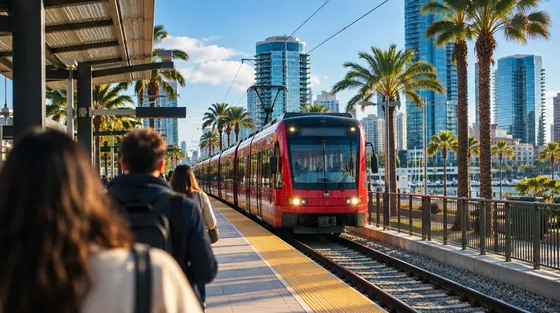
Most San Diegans drive, but transit works well along certain corridors. The Metropolitan Transit System (MTS) runs the trolley and city buses. Current fares:
- Adult: $3 one way, with daily fares capped at $7
- Reduced fare (eligible riders, ID required): $1.50 one way, capped at $3.50 a day
- Youth 18 and under: free on MTS and North County Transit District (NCTD) with a Youth PRONTO card or app
You pay with the PRONTO card or app, a contactless bank card, or cash. PRONTO automatically gives you the best fare. North County is served by NCTD, including the Coaster commuter train along the coast. For a full rundown, see our getting around San Diego guide.
Schools
San Diego County has 43 school districts and about 480,000 students, according to the San Diego County Office of Education. Where you live determines your default public school, so research schools before you pick a neighborhood if you have kids.
San Diego Unified is the second-largest district in California, serving more than 121,000 students from preschool through 12th grade. It has neighborhood schools, magnet programs and charter schools, and it runs an enrollment-options process for families who want a school outside their attendance area.
For higher education, the region has UC San Diego, San Diego State, the University of San Diego and several community college districts.
DMV and registration steps
California expects new residents to switch over quickly. The DMV’s New to California page is the official checklist.
Register your vehicle (within 20 days)
The DMV says a vehicle last registered in another state must be registered within 20 days of becoming a resident, or late fees apply. You’ll need:
- Application for Title or Registration (REG 343), signed by all owners
- Your out-of-state title (and registration)
- Vehicle verification (REG 31), done by DMV staff, law enforcement or a licensed verifier
- A California smog certificate for most gasoline cars from 1976 on and most diesels from 1998 on
- Fees, including registration and use tax. The DMV’s online fee calculator gives an estimate.
The DMV’s out-of-state vehicle checklist has the full list. Book a DMV appointment or check which steps can be done online before you go.
Get a California driver’s license
Once you become a resident and plan to drive, you must apply for a California license. The DMV’s site doesn’t put a day count on its new-resident page, though driver-education sources commonly cite 10 days. Expect to take a knowledge test even with a valid out-of-state license. If you’ll use your license to fly domestically, apply for a REAL ID, which has been required for domestic flights since May 7, 2025.
Other first-month tasks
- Register to vote in California
- Set up electricity, gas, water, trash and internet, and ask your landlord which utilities are in your name
- Update your address with your bank, insurer and the USPS
Before you sign a lease
- Visit at commute time and check your drive or transit route.
- Ask about parking. Many older buildings have limited or no off-street parking.
- Check the distance to the coast. A few miles can change both temperature and rent.
- Read the lease for utilities, pet rules and parking fees, which can add a lot to the monthly cost.
Frequently asked questions
How much does it cost to rent in San Diego?
Zillow's rental data put San Diego's average rent at $3,004 a month as of September 30, 2026. The Census Bureau's 2019–2023 survey put the city's median gross rent at $2,223, but that figure averages five years and includes long-term tenants, so new leases usually cost more.
Can I move to San Diego without a job?
You can, but it's risky in one of the country's most expensive housing markets. Landlords commonly ask for proof of income, so plan on a large savings cushion, a short-term furnished place while you search, and a job hunt that starts before you move.
How long do I have to register my car in California after moving?
The California DMV says a vehicle last registered in another state must be registered within 20 days of becoming a resident. You'll need a REG 343 application, your out-of-state title and registration, a vehicle verification and, for most gasoline cars from 1976 on, a California smog certificate.
When do I need a California driver's license?
The DMV says you must apply for a California license once you become a resident and want to drive here. Driver-education sources commonly cite a 10-day window. Expect a knowledge test even if you hold a valid license from another state.
What is the weather like year-round in San Diego?
Mild. National Weather Service records for Lindbergh Field show average January highs around 65°F and August highs around 77°F, with about 10 inches of rain a year, mostly from November through March. Spring and early summer often bring morning low clouds.
Is public transit good enough to live in San Diego without a car?
It depends on where you live and work. MTS trolley and bus lines cover downtown, Mission Valley, UTC and the South Bay well, and an adult fare is $3 one way, but most of the county is car-oriented, so many residents still drive.
Hours, prices and event dates change. Confirm with the venue or organizer before you go.