Chicano Park San Diego: Murals, History and Visiting Guide
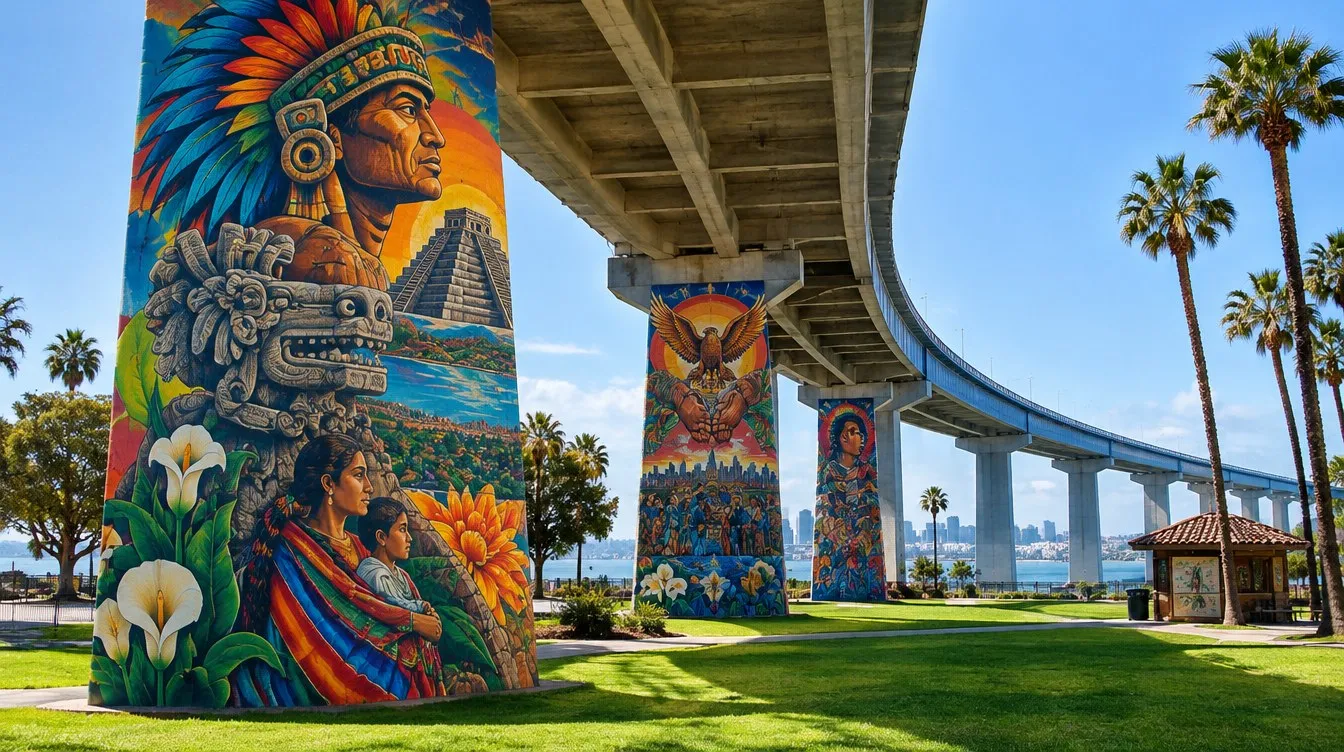
Chicano Park is a free, 7.9-acre public park in San Diego’s Barrio Logan, set beneath the San Diego-Coronado Bridge, and it holds what is widely called the largest collection of outdoor murals in the United States. It was born from a 12-day community takeover in April 1970 and became a National Historic Landmark in 2016. Come in daylight to see the murals, take the Blue Line trolley to Barrio Logan station, and if you can, time a trip for Chicano Park Day each April.
What Chicano Park Is
The park fills the land under the curving approach ramps of the Coronado Bridge where they meet Interstate 5. Massive concrete pylons that could have been grim freeway infrastructure are instead covered, floor to deck, in murals: Indigenous and Mexican imagery, Mexican national heroes such as Juárez, Zapata and Hidalgo, farmworker struggles, community life and the story of the park itself. Between the pillars are lawns and a kiosko (a central pavilion) designed by Alfredo Larín as a tribute to the community’s cultural heritage.
It is a neighborhood park first and an attraction second. On a typical afternoon you will see families, neighbors relaxing on the grass and visitors photographing the pillars. It is also a living artwork. New murals are added and older ones restored, so it never looks quite the same twice.
Chicano Park History: The 1970 Takeover
Barrio Logan is one of San Diego’s oldest Mexican-American neighborhoods, and by the late 1960s it had been cut apart. Interstate 5 sliced through it, and in 1969 the elevated onramps for the new Coronado Bridge divided it further. Residents had pushed for a park, and the city approved one in June 1969, but nothing happened.
Then, on April 22, 1970, a resident named Mario Solis saw bulldozers working on the land that had been set aside for the park. They were clearing ground for a California Highway Patrol substation and parking lot. Word spread fast. Neighbors, students and activists from the Chicano movement occupied the site, planting gardens and refusing to leave. The occupation lasted 12 days, and negotiations with the city followed. On July 1, 1970, $21,814.96 was allocated for a 1.8-acre parcel, and Chicano Park was born. That story comes from the National Trust for Historic Preservation and the Chicano Park Steering Committee, which formed out of the takeover and still looks after the park.
How the Murals Began
Artist Salvador Torres had imagined the bridge pylons as giant canvases. Starting in the early 1970s, he and Victor Ochoa, an early Steering Committee member, recruited muralists to bring the idea to life. Guillermo Aranda, Mario Acevedo, Tomás Castañeda and Michael Schnorr were among the artists who painted the early works. Murals have been added in every decade since, including a 2023 farmworker mural by Mario Chacón, Ariana Arroyo and Gary Hartbur.
The murals have needed care: sun, freeway grime and bridge retrofits all take a toll. Restoration began in 1984, and a 2012 project restored 23 murals over 13 months.
Landmark Status
Recognition came in stages. The park was designated a City of San Diego historic site in 1980, added to the California Register of Historical Resources in 1997, listed on the National Register of Historic Places on January 23, 2013, and designated a National Historic Landmark on December 23, 2016. That last honor, announced in January 2017, puts it in the same category as the nation’s most significant historic places.
Seeing the Murals
The murals cover pylons on both sides of the park and wrap around ramp walls and retaining walls, so plan to walk the whole site. An unhurried loop takes about an hour. Photographers can easily spend two.
Chicano Park map. The Chicano Park Steering Committee publishes a map of the murals with information about the artwork, which is the best way to know what you are looking at. Pull it up on your phone before you go. The park has free public Wi-Fi on the network “SDAccess4All.”
Guided tours. The Steering Committee’s site lists a tour coordinator you can email to arrange a guided visit. A guide makes a real difference here, because many murals carry layered political and cultural meaning that is easy to miss.
Best time to visit. Come in daylight, ideally mid-morning or late afternoon when the light slants under the bridge and the colors are strongest. The San Diego Tourism Authority recommends daylight visits and normal city-park common sense after dark.
Etiquette. Photography is welcome, but this is a neighborhood gathering place and a sacred site to many locals. Keep drones down, don’t climb on the murals or the kiosko, and ask before photographing people.
Chicano Park Day
Chicano Park Day marks the anniversary of the takeover. It is held each April on the Saturday closest to April 22, with music, dance performances, a car show, food, art vendors and speeches honoring the people who fought for the park. It is free and open to all ages. The Steering Committee asks that no alcohol or pets be brought.
The 56th celebration was Saturday, April 25, 2026. MTS listed it from 10am to 5pm, and other listings gave noon to 5pm, so check the official schedule closer to the date. As of November 2026, the 2027 date had not been announced. If the usual “Saturday closest to April 22” pattern holds, the 57th Chicano Park Day would fall on Saturday, April 24, 2027. Watch the Chicano Park Museum and Steering Committee sites for confirmation.
On Chicano Park Day, the trolley is by far the easiest way in. MTS points riders to the Blue Line’s Barrio Logan station.
Chicano Park Museum and Cultural Center
Opened in 2022 after years of planning, the Chicano Park Museum and Cultural Center at 1960 National Ave tells the story of the park, the takeover and the artists. It also serves as a community center. According to its website it is open Thursday to Sunday, 11am to 5pm, and closed Monday to Wednesday. Visit before the park if you can, because the context makes the murals far richer.
Getting There and Parking
Trolley. Take the UC San Diego Blue Line to Barrio Logan station, at 1910 Harbor Drive near César E. Chávez Parkway. The park is a short walk away. It is the next stop south of 12th & Imperial. See our getting around San Diego guide for fares and passes.
Bus. MTS lists Route 12 and Route 901 as serving the area.
Driving. The park sits right off I-5 near the Coronado Bridge. Plan on street parking in the surrounding blocks and read posted signs. On Chicano Park Day, skip the car.
From the Gaslamp. Barrio Logan is just southeast of downtown, so it pairs well with a morning in the Gaslamp Quarter or East Village. It is a quick trolley hop or rideshare.
Barrio Logan Galleries and Food Nearby
Logan Avenue, roughly between South Evans and Sampson Streets, is the neighborhood’s main strip of artist studios, small shops and galleries. The San Diego Tourism Authority highlights La Bodega Gallery, Chicano Art Gallery and CM Curatorial. Gallery hours vary, and many keep weekend or event-night hours, so check before you go.
For food:
- Las Cuatro Milpas, the decades-old tortilla and tamale institution, closed its original Logan Avenue building in late 2025. It reopened in May 2026 a few blocks away in the Mercado del Barrio development on National Avenue, open 8am to 3pm. Expect a line at lunch.
- ¡Salud! is named by the tourism authority as a neighborhood food pick.
Two breweries that appear on older Barrio Logan lists have closed: Iron Fist Brewing’s Barrio Logan tasting room closed in 2020, and Border X Brewing closed its Barrio Logan location in January 2025.
Who It Suits
Chicano Park is a must for anyone interested in public art, Mexican-American history or civil rights, and it is one of the best free things to do in San Diego. Families will find open lawn to spread out on. Photographers get some of the most striking backdrops in the city. Plan two to three hours for the park, the museum and lunch on Logan Avenue.
Frequently asked questions
Where is Chicano Park in San Diego?
Chicano Park is in Barrio Logan, part of Logan Heights, directly beneath the San Diego-Coronado Bridge where it meets Interstate 5. The Barrio Logan trolley station on the Blue Line, at 1910 Harbor Drive near César E. Chávez Parkway, is the closest transit stop. The Chicano Park Museum is at 1960 National Ave.
How many murals are in Chicano Park?
Chicano Park holds what is widely described as the largest collection of outdoor murals in the United States, painted on the bridge pylons, freeway ramps and retaining walls. The count changes as new murals are added and old ones restored. The Chicano Park Steering Committee publishes a mural map with details on each work.
What happened at Chicano Park in 1970?
On April 22, 1970, residents found bulldozers clearing land that had been promised as a park, to build a California Highway Patrol station. Neighbors and Chicano movement activists occupied the site for 12 days until the city agreed to make it a park. On July 1, 1970, $21,814.96 was set aside for the first 1.8-acre parcel, and the murals followed.
When is Chicano Park Day 2027?
Chicano Park Day is held each April on the Saturday closest to April 22, the anniversary of the 1970 takeover. The 56th celebration was Saturday, April 25, 2026. The 2027 date had not been announced as of November 2026. If the usual pattern holds it would fall on Saturday, April 24, 2027, but confirm with the Chicano Park Steering Committee.
Is Chicano Park a National Historic Landmark?
Yes. Chicano Park was designated a National Historic Landmark on December 23, 2016, and the Interior Department announced it in January 2017. It was already on the National Register of Historic Places (2013), the California Register of Historical Resources (1997) and a City of San Diego historic site (1980).
Is Chicano Park free to visit?
Yes. Chicano Park is a public city park open to everyone at no charge, and Chicano Park Day is a free family festival. The nearby Chicano Park Museum and Cultural Center is open Thursday to Sunday, 11am to 5pm. Check its website for any admission details.
Hours, prices and event dates change. Confirm with the venue or organizer before you go.